Thursday, August 20, 2015

Iceland: No one place like this one

Iceland reminds me a bit of Alaska, a little bit of Colorado and a part of old Austin, Texas from twenty years ago. And so far, it's our favorite adventure of all of our recent travels. As Stephen Markley says “The problem with driving around Iceland is that you’re basically confronted by a new soul-enriching, breath-taking, life-affirming natural sight every five goddamn minutes. It’s totally exhausting.” We decided to pace ourselves and just take on part of the island. It was still beautifully exhausting.

We arrived in Reykjavik on a Saturday night. We shuttled into the city and checked into our rented house for the
week. It was formerly a rectory from the church next door - an old house with a bunch of character on a lazy street next to downtown Reykjavik. Our daughter Erin and her husband Seb had already arrived and unpacked after their 3 day hike in the middle of the country. They greeted us with hor d'oeuvres and drinks and photos of their hike. We relaxed that evening but couldn't wait to get started with the city the next day.

The weather was warm (for Iceland) as we hiked around Reykjavik. We walked to the harbour and easily found the Hofdi House - a historic place that is not open to the public. It was formerly a home of the French consul, then the British ambassador - until he moved out due to a ghost called "the white lady." Most importantly, this is the location when Reagan and Gorbachev met to try to dissolve the cold war in 1986. No agreement was made in 1986, but it was the start of talks between the two leaders which lead to the destruction of the Berlin wall. This house was ordered from a catalog in Norway. Iceland has very little timber therefore wood is not used in construction of buildings. We passed the many unique tourist shops and restaurants on our walk and the vibe of the city was vibrant, quirky, interesting, and friendly.

We came to the church that is a famous icon of Reykjavik - the Hallgrimskirkja. There was a wedding going on so visiting the inside of the church was not possible. We rode the elevator up to the tower to get a view of the city however. We also played with the mirrors outside
that resulted in some funny looking selfies. We walked back toward the harbour toward Harpa - the town's concert hall and convention center. We went crazy taking photos of this building, both inside and out. The angles of the glass gave us some fun photos. We
could find ourselves in the sections of glass the light reflection gave us some great photos. We noticed a large yacht off the coast near Harpa the music hall. Larry Ellison was parked out there and we saw his helicopter come and go. We bought tickets to Pearls of Iceland - a concert with original Icelandic songs and we relaxed for a bit while listening to the music. The language of Iceland sounded like Russian to me. Erin and Seb cooked dinner that evening in our house - Icelandic cod and a nice salad.

Monday we were to drive the famed Golden Circle, the 300km loop towards the center
of the island. We woke up to a call from the rental car company that "our car" had been involved in an accident the day before and we would be delayed by 3 - 4 hours to begin our drive. The sun doesn't set until 11:30 at night, so we were trying to be patient about our timing. Around 1pm we got our car and we drove to the  Thingvellir national park when the east and west continental plates meet. It's like a deep divide between the two sections of land. We hiked for a bit and then drove to Geysir. Geysir is the original geysor and is the namesake for all erupting hot springs. It was pretty reliable, spouting every five minutes or so. The action of the bubble before eruption was mesmorizing.
We continued to Gullfoss - the waterfall of all waterfalls. Since the sun was out, we experienced many rainbows there - we felt like we were wearing them in fact. We captured over 400 photos of our day's adventures.

We arrived back at 8pm and went to a restaurant that Erin and Seb had tried a few nights
earlier that is so hip it doesn't even have a name. It goes by it's address Hverfisgata 12 or "Pizza that has no name". There isn't a sign outside either exhibiting unique marketing. We entered and felt like we were in Austin, Texas. The staff was extremely helpful. I couldn't decide between the beet pizza or the Etruscan Elite with rocket and walnuts. The Etruscan pizza was amazing.

Tuesday was our day for a hike near Skogafoss - the tallest waterfall in Iceland. Erin and Seb decided on the 10 hour hike from Skogafoss across the glacier to Thorsmork. We opted for a shorter hike so we could take our time with photos and avoid the technical hike near the end. Our plan was a good one as we passed over 15 waterfalls in succession on the side of the volcano Eyjafjallajokull  that disrupted airplane travel five years ago. It's hard to describe the feeling that day as we hiked. It was "soul-enriching, breath-taking, life-affirming" for sure and made me emotional in appreciating
the opportunity to be there. We returned to the city to eat at Icelandic Bar, known for the fish and chips. The cod was the best I've had and the sweet potato fries substitute for the chips was a great choice. Erin and Seb arrived home around midnight from their hike and Paul walked downtown with Seb to grab a late night hot dog made of lamb at the stand near the harbour.

Wednesday was our day to indulge. As required, we bought our entrance
tickets to Blue Lagoon before we arrived. We showered naked before entering the hot mineral pool to adhere to the strict health requirements. I lathered up my hair in conditioner as well to keep the minerals from drying it out. Our entrance package gave us a drink, a mud pack and mask. The combination of warm mineral water, a glass of champagne, and our facial mask gave us an odd combination of giddiness, relaxation, and tranquility. What fun we had! We took a group photo of ourselves with our mud masks on. The minerals really do make your skin soft and the mud masks make you laugh at yourself. We had been afraid the experience might be too touristy at first, but later decided that it was one of our favorite days.
That evening, we had reservations at the world-renowned Dill restaurant. We discovered that the owners of Dill also owned the pizza restaurant we had eaten at a few nights before. We were finding the restaurant scene in Reykjavik  fairly remarkable. We knew it would be an expensive night, but we opted for the 7 course dinner with wine pairings (how often do you get to go to a famous restaurant, right?).
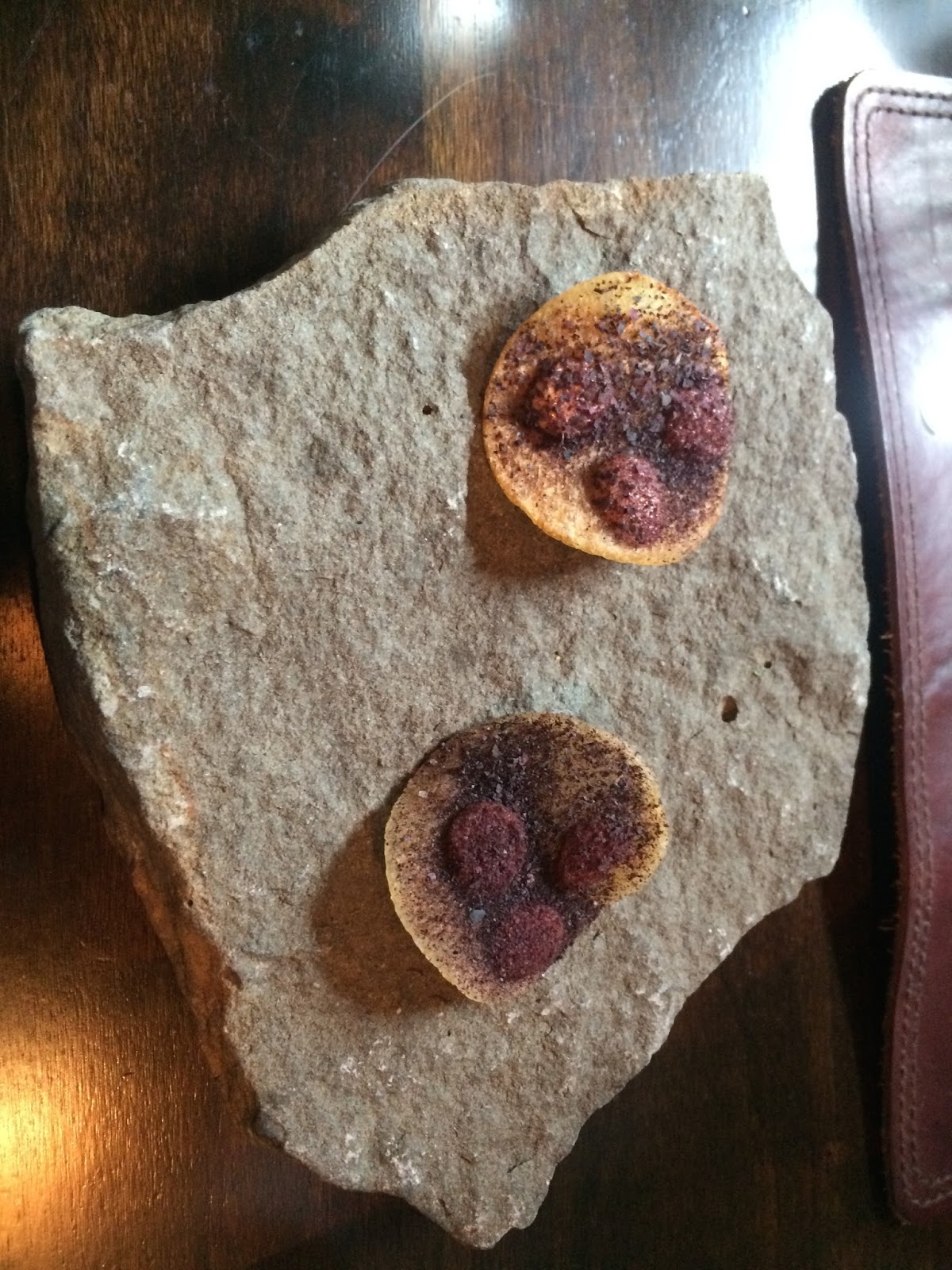
The first course was a pickled carrot sandwich.  It had cream cheese and caraway sandwiched between the two pieces of carrot - about the size of a dime.  Another course was a beet flower. The vegetarian version of that had tarragon seeds in the center with roasted yeast. The meat version had liver. The next course was a potato chip with toasted peppers with seaweed. My favorite course was the beet quinoa dish with cheese and lava salt. The dessert of burnt bay leaf ice cream was remarkable as well. The wine pairings were also varied, combining fermented beers and white and red wines to our delight. My body was treated to tastes and mineral immersions that day to both excite and soothe.

Considering the advice of friends who had visited Iceland, we decided to
undertake the 5 hour one-way drive to go visit Glacier Lagoon, locally called Jökulsárlón near the Vatnajökull National Park. The drive there was long but scenic. We saw many horse farms for which Iceland is famous. The horse there has a particular stride that is different than any other horse in the world. We were close to the coast several times but resisted stopping as the day would be long just to reach the lagoon. We had to gas up whenever we saw a station because there were not cities on this part of the island. We saw bright green mountains along our way. Then the terrain changed to barren tundra fields covered with volcanic ash and lava. In the distance, we could see the
glacier. Unexpectedly, we crossed a one-way bridge and the glacier was right before us. On the other side of the bridge was the Atlantic Ocean with chunks of glacier floating in it and covering the beach. We spent several hours taking in both sides of the highway, near the glacier itself and then near the lagoon with the beach. We ate our packed lunch on top of lava rocks over looking the ocean with chunks of ice breaking off and floating away as we ate. After we exhausted the photographers in the group, we headed back home with a couple of stops along the way near beaches that had rock formations, caves and the exotic puffins flying along the rocks. We arrived back in the city and quickly grabbed a bit to eat to finish the day.


Friday was our last day in Reykjavik. We were definitely not interested in getting back in the car after our travels the day before. We indulged in a brunch at the Coocoo's nest near the harbour in an area that we not previously visited.  Interestingly, a sign along the way pointed us to a Texas restaurant offering "Texasborgarar", which we assume were burgers. The Coocoo's Nest also screamed hipster, but it was low-key, organic, quirky and fresh. The homemade bread itself looked worth the visit alone. The music playing was blues and soul.  I had a salad with walnuts and cranberries with a piece of the homemade bread. The open faced sandwiches looked hearty and tasty. We left to walk off lunch and got lost on the way back. We came across a park filled with locals, mothers with children and older people feeding birds and sat and people watched for a while. We meandered home and relaxed for the afternoon.

Around five, we met Erin and Seb at Slippbarinn - a trendy bar in the lobby of the Austin-esque Marina Hotel prior to our dinner reservation at the GrillMarket - a place to celebrate our last night in Iceland. The cocktails were very creative and it was difficult to choose. I chose a Pippi Gonzales - tequila, dill, cucumber, lemon, and dill-infused olive oil. Paul chose the Borderline -  a stout liquor, vodka, cream and roasted hazelnuts. His drink was like dessert. They had several interesting drinks, including ones with bacon-infused brandy, birch,  and mezcal. The Grillmarket was close by.  Most of their menu items were grilled meats and fishes, but the sides were tasty for the vegetarians. Before we left, we toasted the adventurous week with our daughter and son-in-law, celebrating Iceland and it's beauty. We each commented on our favorite days and it was noteworthy to see that we all chose a different day's adventure.

Iceland Air allows travelers between Europe and the US to stopover at no additional cost on airfare. It is definitely a place to which I would return.There is no one place like this one.

Wednesday, July 8, 2015

Paradise Found - Italy

I. Love. Italy. I held in one hand the Italian people and their celebration of life with the love-of-the-moment attitude. And in the other hand, I held the rich historic culture with the exquisite religious art literally everywhere. At the same time I was bathed in the beautiful countryside while drinking intense Italian red wine and eating the most gratifying food I've had in a long time. It was all simple, delightful, and intensely heavenly, the combined adventure unlike anything I had experienced before. I wanted to receive all that Italy had for me.

We spent the previous week visiting Sicily to see where Dad fought Retracing Dad's Steps in Sicily and then explored Rome, the Amalfi coast and Pompeii. We were now ready to set off to Tuscany for our next week's adventures. We took a train from Rome to Pisa to pick up our rental car to avoid having to drive around Rome or Florence. We took a cab from the train station to the airport to find our car. But first, we stopped at the leaning tower of Pisa. Our cab driver dropped us off at  and waited with our luggage at the taxi stand near the Piazza del Duomo or Cathedral Square. The tower was built in the 12th century and has been recently reinforced so that it won't topple over. It was a quick stop for us, but one we couldn't miss.

We arranged our car and after a two hour drive, we arrived near Badia A Passignano to negotiate the gravel hilly one-lane roads that lead to our cottage for the week. We booked a cottage with AirBnB and it was really a nice place to be our base for the week. Our cottage was over 300 years old, but nicely restored. The kitchen was well-stocked with cooking supplies. The scenery was breath-taking. We bought groceries on the way in and knew that we wanted to rest a bit from Rome and Amalfi coast drive before visiting the nearby villages.


We took it easy on Monday with just a wine tasting and dinner in nearby Greve. The next day - on Italian Unification Day, we meandered into Badia a Passignano to look at the church and little village. We had dinner at Antiga Scuderia. It was probably my favorite dinner with truffles scattered on every dish we ordered. We overlooked the vineyards in the evening as we relaxed on the outside patio. On a Tuesday evening, the restaurant was completely booked in this tiny village.

The next day was our adventure into Florence.  We drove to a nearby small
town named Galluzzo from our cottage and parked the car in the town square to take advantage of all day free parking. We purchased round trip bus tickets at the news stand and took the 20 minute bus ride into Florence's main bus station. The larger Italian cities have ZTL's which are limited traffic zones. The fines are quite large if you even attempt to drive into the city ZTL's - most of which exist at the city's walled borders. We had an appointment at 11:00 to visit the Accademia to see David and then at 1:30 to visit the Uffizzi. By purchasing the tickets in advance, it avoids the hour long waiting in line to visit these popular museums. We arrived in time to take a quick trip to visit the Duomo - officially called Santa Maria del Fiore. It is the predominant church in Florence and featured in the skyline with it's tall dome. We also visited the Basilica of Santa Croce. This church was Michelangelo's neighborhood church, built in the 13th century, and it is where he is buried. I had previously visited this church for mass when my daughter studied abroad in Florence. It is staggering to walk in the footsteps of the great artist Michelangelo.

Michelangelo's David did not disappoint. After reading the Agony and the Ecstasy which tells in detail about Michelangelo's quest for perfection, I was impressed with all aspects of this masterpiece - including the perfect Carrara marble and the detail of the body of David. Michelangelo's slaves are also in this hall. They are his unfinished works which give insight into the process of creating these masterpiece sculptures. Boticelli has a sculpture here and Giambologna's Rape of the Sabines is also exquisite. We left after an hour to find lunch. We grabbed a quick bit of pizza at a nearby restaurant and then proceeded to the Uffizzi for our appointment there.

The Uffizzi was built by the Medici family as offices  and to house their art
collections in the 16th century. The building itself is a masterpiece located by the Arno River and the bridge that crosses it - the Ponte Vecchio. It was said that the famous artists Michelangelo and de Vinci used to hang out at the Uffizzi for it's beauty, to work and for recreation. We looked forward to seeing the art representation of the Ninja Turtles, Leonardo, Raphael, Michelangelo and Donatello. We left the Uffizzi after three hours into a 92-degree sweltering day. We briefly visited the Ponte Vecchio and scrapped our plans to see the Piazzale Michelangelo, the Basilica of San Miniato, and the David sculpture there near the hilltop of the city overlooking the Ponte Vecchio. It gives an iconic view of the city. We did stop long enough to grab some gelato before we walked to the bus station to bus to our car. We recovered from the heat on the deck of our cottage as we ate leftovers.


 We visited San Gimignano, a 14th century walled city,  the next morning early to avoid the heat of the day. It was expected to be over 94 degrees in the afternoon and we intended to be in the pool near our cottage before 2pm to offset the heat. The weekly market was already set up in San Gimignano when we arrived.  We bought tickets to climb the city tower and take a tour of the church. The view was amazing from the top. We grabbed some Italian pottery and a Tuscan tablecloth as souvenirs from the market and then bought dinner from the market stalls, including some special cheeses, fresh pasta, sausage and some bread. It would have been easy to stay the day here visiting the shops and outdoor cafes. It is by far my favorite Tuscan village. However, we cut our visit short to visit nearby Volterra for lunch before we finished for the day. In Volterra, we drove up the incline to the walled town on the hill. We parked and visited a small cafe in the shade to watch the
tourists and townspeople. I ordered Tuscan bean soup and a salad with a glass of Vino Nobile di Montelpulciano red wine. We were exhausted as we pulled into the cottage at 3pm. This region of Italy also takes time for an afternoon "siesta". We joined in the tradition, wiped out by the heat.
We traveled to Siena the next day. Siena was settled in 900 - 400 BC by the Etrusians and Augustus ruled here as well. We looked forward to seeing one
of the oldest cities of the region. Siena was the hardest city to drive near and parking - though well scoped out - was difficult as well. We were lucky finally to find a street spot across the river, though we may have driven into a ZTL by mistake. We'll find out via mail whether or not we were given a hefty fine. Il Campo is the piazza that is the most famous. This large area hosts horse races a couple of times a year and we just missed a jousting festival by one week. On this day, it was a lazy day in the area where there were only art students sitting and drawing perspectives of the Duomo. We walked to the Cathedral and purchased tickets to enter. Next to the Vatican, this 13th century church was our favorite. The black and white striped exterior represents the black and white horses of the city founders Senius and Aschius, sons of Remus. There were two more Michelangelo sculptures inside as part of a side altar, St. Paul and St. Peter. Michelangelo wanted to complete this altar but instead was called to paint the Sistine chapel. There are 172 busts of popes along the moulding. Bernini designed the dome as a golden lantern and sculpted two statues - Mary Magdalene and St. Jerome and Donatello has a painting and also a bronze St. John the Baptist in this cathedral. 
We left Siena before noon and traveled to Monteriggiani for lunch. This is a very small walled village with a castle and  it was a great place for a lazy afternoon and a great lunch. The entire town has perhaps 20 businesses and fortunately for us, 8 of them were restaurants. We chose Restaurant da Remo il Poccolo Castello, right next to the church. The lunch menu was creative with daily specials. The menu was heavy with meat selections so I chose a sample plate of several pasta dishes so I could taste a bit of several of the side dishes.  The pumpkin risotto was light and delicious.  The spaghetti with ricotta and spinach was very tasty and fresh. Paul's meat dish was browned in flour and he found it a bit heavy for lunch. We sat on the patio but quickly moved inside where the stone walls kept us cool during the very hot afternoon.

When morning came, we had to check out of our cottage. We were sad to leave it - it was very relaxing for us and the stone kept us cool. However, the best was yet to come. We booked our final two nights at a castle -  Castelle Delle Serre -  in a different part of Tuscany near Serre di Rapolano. We couldn't check into the castle until 3pm, so we travel to Montelpulciano for lunch and wine tasting at Bottega Del Nobile. Instead of visiting each vineyard, this setup allowed us to buy tastes of all regions of Italy, including bold Brunellos and Vino Nobile wines from Montelpulciano. There were over 300 wines available to taste. We were treated to years-old Grappa, which tasted like whiskey.  The food was touted to be fantastic as well, but we found it was prepared ahead in another kitchen and transported in. However, my pici pepe was really nicely seasoned and perfectly cooked and my sister enjoyed her Tuscan rabbit (served in a jar). We walked the city and ended the day there with some gelato.

We traveled back to the castle and this 12th century built, recently restored castle was
quite a treat. The owners, father and son Salvatore and Antonio Gangale purchased the property in 1994 and it took eleven years to open up the first three rooms. It had always been there Salvatore's dream to return to Italy from California and he bought the castle in a state of disrepair. It had been neglected since WWII essentially. Perseverance paid off  - the last rooms were just opened.  It has a swimming pool with cabana that is above the town. From the decks of the pool and from our room's windows, you can see the surrounding countryside.  We spent the evening at the pool and ordered a bottle of wine to enjoy on the deck. It was hard to believe that we were staying in a medieval castle with such modern amenities. Antonio spent extra time giving us hand-written directions to see the best views in the area and the best little towns to visit in our last two days there. Salvatore gives cooking classes on Tuesdays and cooks dinner for guests on Saturday evenings as well.

Sunday afternoon after the church bells announced the ending of mass, we walked down the cobblestone path to a very small, family owned restaurant for lunch - Ristorante pizzeria San Rocco. There was a big local Italian family gathered there and we enjoyed the experience of watching them interact with each other. The food was delivered family style and the loud laughter of the group made it seem like a celebration with ages 85 to 2. After lunch we drove back to Montelpulciano to buy a few cases of wine to ship home and along the way spent some time  near Montelcino photographing Val d'Orcia - the most photographed fields in Tuscany. The movie "Under the Tuscan Sun" was filmed here. The skies darkened on our final drive to enhance our final photographs.  We left with several thousand photos, a case of wine, and a deep desire to return to Tuscany.

Sunday, June 14, 2015

Retracing Dad's Steps in Sicily - World War II


My sister and I, with our husbands, arrived in Sicily and immediately noticed the rugged ancient hilly environment. On the hillside, there were abandoned houses that looked to be about 1000 years old – literally. We drove from Catania airport to our base at the Hilton Resort in Giardini Naxos near Taormina, the eastern side of the Italian island. Our hotel view was of the Sicilian beach, but we immediately went to the other side of the hotel to view Mt. Etna. As my sister said, “Dad only said about seven words about his experience in WWII, and two of those words were Mt. Etna.”  We were now looking at what Dad saw when he arrived the beginning of August in 1943. We were to meet our guide the next morning to have him accompany us to the region where Dad fought, to see the terrain, if not the spot where Dad fought and was injured for the first of three times in the war. 
Dad’s march in Sicily - From After Action Reports July 31 - August 14, 1943. (WWII era photos from Robert Capa):

Dad had already served under Patton in Tunisia – arriving in North Africa April 13, 1943. After success in Tunisia, his Battalion left the port of  Mers El Keber – half way between Casablanca and Tunisia -  for Sicily  on July 29th aboard the ship S.S. Orbiza They arrived in Palermo, Sicily late afternoon July 31st.  It was too late to unload the ships so they stayed the night on the ship. At 4am, the next morning, German planes raided the harbor. The first attack was for 50 minutes and a second attack followed 15 minutes later lasting for 25 minutes.  Fortunately, no ships in the harbor were hit by German bombs.  Later that afternoon, the regiment disembarked and marched 15 miles southeast of Palermo to a bivouac area.
Starting at 11am, August 2nd, the regiment moved by motors to an assembly area approximately 7 miles east of Nicosia, Sicily. The equipment arrived August 3rd and the Regiment got ready for combat. After the officers reported to headquarters,  they were told that they were supposed to be on Mt. Pelato by late August 5th or early August 6th.  And their movement was supposed to be “with utmost secrecy”  so the Germans would be taken by surprise. They would move along the ridge line to the east and take the ground in the area of Mt Camalato. This would prevent the Germans from using the road between Cesaro and San Fratello, a major north-south passage. Afterwards, they were to take the town of Cesaro with the 47th Infantry who was coming from Troina to Cesaro. To keep it secret, the movement of the troops would be at night. So during the night of August 3rd,  the 2nd Battalion moved to an area southeast of Capizzi., had four hours rest and then moved to north of Capizzi. A German detached patrol, estimated as a patrol, with pack mules was surprised when the leading element reached Mt Camelato. They fled, leaving their equipment, arms, and animals.

On the night of August 5th, the 2nd Battalion moved from their position following in the footsteps of the 1st Battalion. They arrived northeast of Capizzi just after daylight on the morning of the 6th after a very difficult night march over very rough terrain.  Dad was in Company E and was lead by Stephen Sprindis (who would later make a name for himself in Normandy). The 4th Tabor Goums (French Moroccans) were attached to the Regiment and were directed to move to Piazza Tredicno with the mission of getting reconnaissance to the north and east of the regiment as it advanced. Also late on the 5th, Anti-tank equipment moved into the area north of Capizzi. It was too difficult to get most of the equipment into the area so they reorganized into a “Pack Howitzer Company”.  They used mules from area towns to bring in what equipment they could. 

The night of August 6th, the Battalions advanced with the 1st leading the way, the 2nd taking over where the 1st had been and the 3rd Battalion keeping the stronghold behind the 2nd Battalion.  They fulfilled their mission of taking Mt. Pelato by the 6th of August. 
The morning of the 7th of August at 05:30, they were directed to seize Mt. Camelato and then join the 47th Infantry and capture Cesaro – an area where Germans were concentrated as they fled the American troops. As movement began, there was contact with the enemy and there were heavy concentrations of mortar and artillery fire. To the rear of the 2nd Battalion, there was an ambush by an enemy patrol estimated in number at approximately 30 men. The IV Tabor Goums returned to the area with 3 German prisoners. They found a considerable number of enemy on the forward slope. An artillery concentration was put in place and as soon as the artillery occupied its new position, the enemy was attacking. The enemy had excellent observation from the high ground to the northeast.  At 10:00 the 2nd Battalion was ambushed by a strong German patrol and caused 5 casualties.

Due to heavy fire, 100 men from the 3rd Battalion to the rear were used as litter bearers to evacuate all the wounded from the 1st and 2nd Battalions to the rear of the front lines using poles and blankets as improvised stretchers. There were 27 dead and over 100 wounded. It was difficult to extract the wounded and took until morning – about 12 hours - to get them all out over the difficult terrain.
Dad was one of the wounded from this day. He was hit in the leg and received a Purple Heart for his bravery. He was taken via ship to a hospital in England where he remained for 2 months to recover. Dad’s brother Harold visited him in the hospital and then sent Dad’s Purple Heart and the shrapnel from his leg to their parents to keep. Dad was returned to duty after he recovered. Another brother Frank also served in Sicily but managed to come out of that battle without injury.

The Germans were on the run and a week later on August 14th, the American  troops reached Floresta, Sicily. Germans blew two bridges on their way out as well as mined and cratered the main road. The Germans had reached Messina on the coast to leave Sicily altogether. Some Italian soldiers left in towns surrendered without offering any opposition. This closed the Sicilian campaign as Mussolini surrendered and Germany lost Sicily.

Our Experience Following Dad’s Steps

Marcello, a native Sicilian, met us in our hotel lobby at 09:00 and we started by showing him the combat maps that we had of Dad’s Battalion during the weeks of August 1 – 8th, 1943. Marcello was an archaeologist by trade but worked as a tour guide to supplement his income. He had some knowledge of Operation Husky and knew the area very well.

We asked him to start our tour in Capizzi, since that would be the closest town to where Dad fought. He immediately declined to take us there.  He essentially said that we would not be received well in the area for several reasons. First off, he said that by the time the battle took place, the Germans had already left Sicily for the most part. They left a few patrols to move around and shoot to make it look like there were many Germans left on the island. Secondly, Patton wanted glory so he came in and bombed the area (after the Germans had left) so that he would look good. The citizens in Troina and Capizzi met the US military with white flags out. Many Sicilian citizens told the soldiers and commanders that the Germans were gone – there was no need to bomb. Finally, Patton brought in mercenary soldiers called Tabor Goums (who were French Moroccans) according to Marcello. These soldiers went into Capizzi and ravaged the town, by murdering and beheading citizens, stealing and violating women and children.  Most people in Capizzi were still affected by WWII and he would not take us there. He also said it was a rugged part of the country infested with wild boars and was only reachable by foot using an abandoned rail road to get there. Besides, we would not have the vantage point to see the battleground from there.Our hopes were dashed - we would not be walking on the ground where Dad was injured as we did in France.

Marcello suggested that we go to Troina instead, a city that had a vantage point of the battlefield. Troina was settled in the 7th century BC by the Greeks and there have been Roman baths discovered from the 4th century BC.  This town was conquered by the Normans in 1061, led by Count Roger and  he established his residence in Troina, founded the monastery of San Basilio and the first Norman diocese in Sicily. (Marcello thought it was ironic that our Dad also served in Normandy, right after he served in a town settled by the Normans).
 
 We stopped about 30 minutes prior to reaching Troina to stop to take in the beauty of the area. The impact of the terrain was ominous as we thought of our Dad fighting near here. There were mountain villages that were built in the first few centuries and at the top of the mountains were caves and tunnels that were still in use. We shot some photos and climbed back in the car to visit Troina. Marcello mentioned that he would try to find older citizens in the area so that we could talk to them about what they remember and what it was like for them.


As we pulled into the city, we temporarily parked at a gas station and Marcello went across the street to the jeweler to inquire who might have knowledge of the war. I found a poster showing the citizens of Troina welcoming the US soldiers in 1943. Within a few minutes he came out and told us that he called the town historian Basilio Arona who immediately closed the doors to his shop and would arrive in minutes to show us around. He assured us that Sicilian people were always helpful and he knew that the whole town would help us find the information we wanted. Basilio arrived and we found that he knew no English so Marcello served as translator for our many questions. Basilio told us to get in our car and follow him to the base of the older part of town and we would take the bus up the mountain to view the hills northeast of Troina where the fighting took place. We parked our car by an 11 th century St. Augustin church and jumped on the city bus which took us to the top of the town. 


From this point, we could see the entire landscape of the Nebrodi National Park that served as the battleground during the war. Basilio inquired which unit our Dad was with and then proceeded to point out where the Germans were pocketed and how the battle progressed by day. By the recently-constructed dam was the area where 30 Germans were pocketed and shot freely at the US troops for 2 1/2 days while the rest of the German troops abandoned the area towards Cesaro.  The Germans used tunnels to store their weapons near Cerami, southwest of where we stood, and where more Germans were located. A bigger battle occurred there with hand to hand bayonet fighting involving US troops and Germans. Basilio pointed out Mt. Pelato and we recognized this name as the peak where Dad was wounded August 7th. Mt Pelato is in the hills to the right of the dam - the bald peak near the horizon mid-picture. That day, Mt Pelato was shadowed by a puffy cloud that stayed overhead, making it easy to identify which hill it was. We asked if they know how the injured were evacuated and they supposed they were taken out by their fellow soldiers or by mule over the top of the ridge to the port in Messina, though they could have been taken back to Nicosia to a bivouac area with road access to Palermo and waiting ships.


We followed Basilio through a neighborhood, into a building, and up some stairs to a museum that was being constructed. One room had costumes from medieval times. Another room had about 15 photos and newspaper articles from the 1940s and WWII maps of the Sicilian Campaign.  We were able to stay for a few more minutes before the museum closed for siesta hours. Basilio promised to send us copies of the photo set by Robert Capa.
 We walked back down the street to the base of the city to our car.  As we walked along, Basilio told us about various buildings along our walk. One wall remained from the 12th century. The Augustine church near our car had workers inside restoring the building. Basilio bought us a coffee and wouldn’t let us pay him for his time. As Marcello translated, Basilio said it was his honor to spend the day with us. It made his day to give us the story of our father.  

Right before we got to our car, I saw another poster made from photos of Robert Capa from the battle during World War II. It has a city wall that was damaged by bombing and from there a viewpoint of the 11th century Augustine church at the base of the town, where we parked our car. The city wall was damaged in this photo, but then restored after the war and that is where we stood with Marcello and Basilio to discuss where our father fought.  Seventy-two years have passed between Dad being here and our visit. Though he never talked about it, I felt a closeness to our father, who was 21 when he fought in this region. My dad was a hero, several times over. He carried those horrible memories privately to his death. I marvel at what it took to face the enemy and come out a hero. To mourn is respectful, to remember is holy.


Wednesday, December 3, 2014

Barcelona: Unfinished Business

I remember playing a classical piece on the piano and playing every note but the last chord, leaving others in the room unsatisfied at the ending since they were expecting to hear the chord that finished the song. That is how I felt when I left Barcelona - there was so much left undone to feel finished. It is definitely a city I would like to visit again.

We arrived late Thursday evening and took a cab to our hotel called Hotel Jazz. It was located near the University area, not far from the Las Ramblas, and close to the Latin quarter and a short walk from the beach. The hotel had a rooftop pool and bar and overlooked the University area. We dropped our suitcases and immediately walked to Las Ramblas for some tapas and sangria. I had heard that the food was not so great on the Las Ramblas because it was a touristy area, but either because we were hungry or the food had some spice, it was tasty to us.

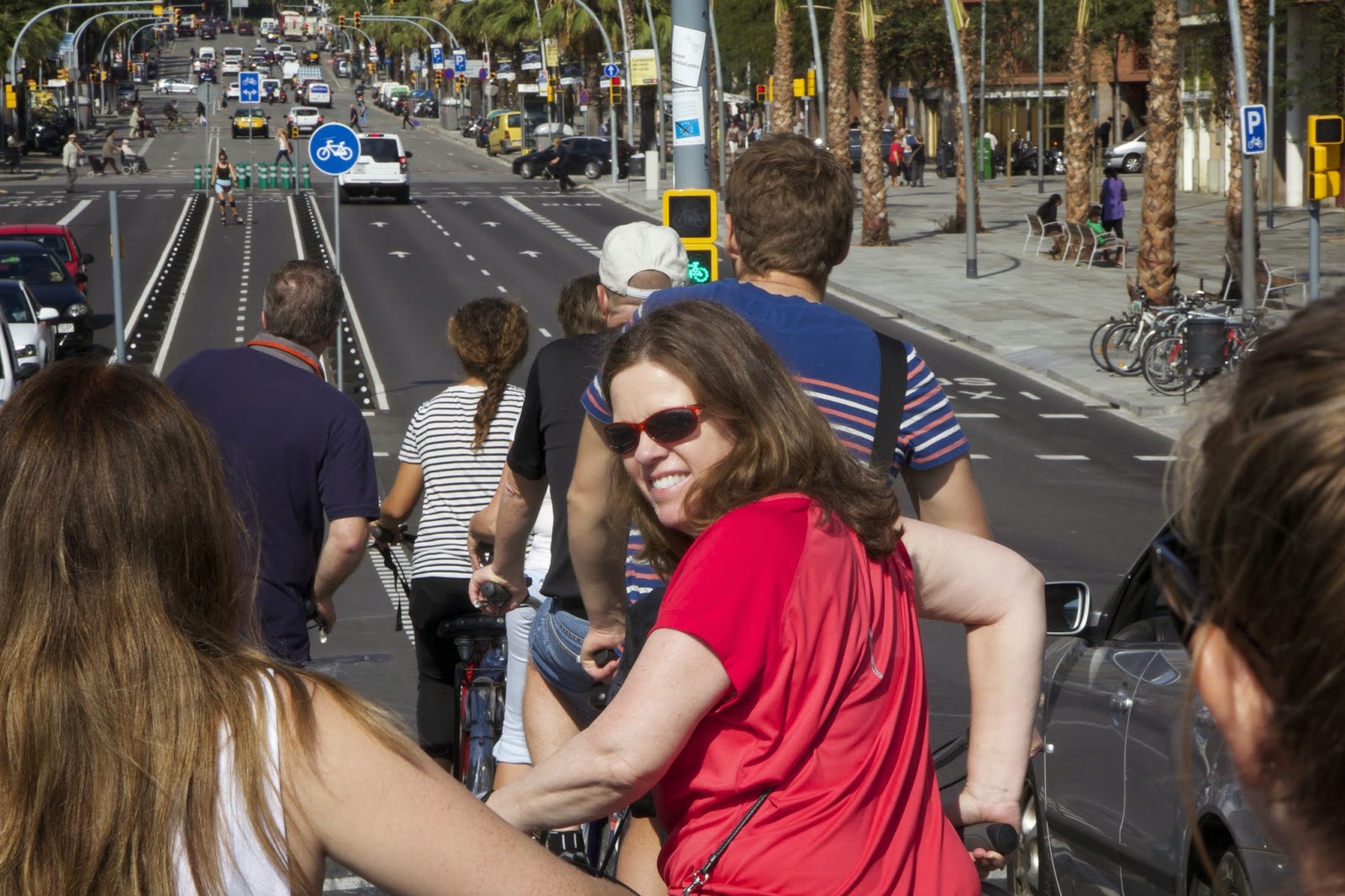
The next morning we walked through the Gothic Barrio to Plaça Sant Jaume to meet Austin, Texas based Fat Tire bicycle company for a bicycle tour of the city. We did the same in Berlin and knew that it was the best way to get a feel for the city, as well as a way to get some exercise. It was a four hour tour and included some highlights of the city, including the government area of town in Placa Sant Jaume and the nearby Plaza del Rei where Christopher Columbus accepted the funds from Queen Isabella for his voyage west (to actually what is now Bermuda and an island called Hispaniola - not North America as most people think). Queen Isabella is reported to have had a personal relationship with Columbus, but also struck a deal to get 10 percent of the trade that he sold.  It felt amazing to be in this historic plaza.

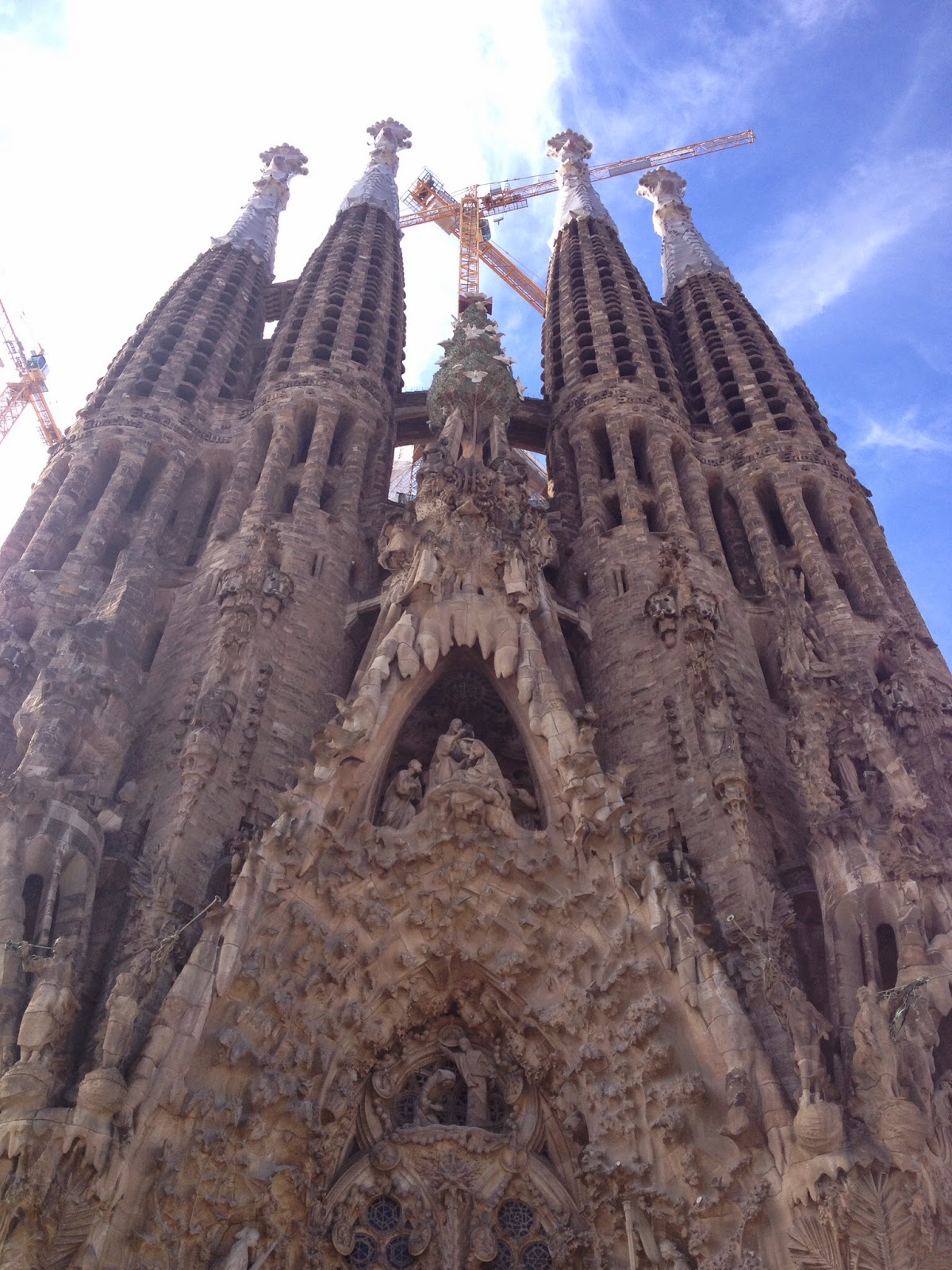
We then rode to the Catedral in the Gothic barrio,  to the beautiful historic Palau Musica (music palace), then onto the  Parc de la Ciutadella which was first a fort, then turned into a park and a zoo. We stopped for photos before riding to the other side of the city to the La Sagrada Familia Catedral designed by the famous architect Gaudi. It was the first glimpse of this church and left us wanting for more. The style of this church from the outside was impressive, but we only had time to see one side and no time to go inside at all.

On the way to the Barceloneta beach, we rode through heavy traffic to find  lunch at another Tapas bar (Tapa Tapa). The beach was busy on the sunny day and we had time to enjoy our Spanish wine while watching the locals sunbathe.  Paul quickly downed his lunch so he could get some photos of the beautiful beach and perhaps a peek at the topless sunbathers. We finished our ride by seeing the Arc del Triomf, the Olímpica village of Barcelona, the eclectic El Borne neighborhood with restaurants and boutiques, and we finished our tour with the Basílica de la Santa Maria del Mar. We were impressed by the diverse offerings of the city and got a glimpse into the history of Barcelona.


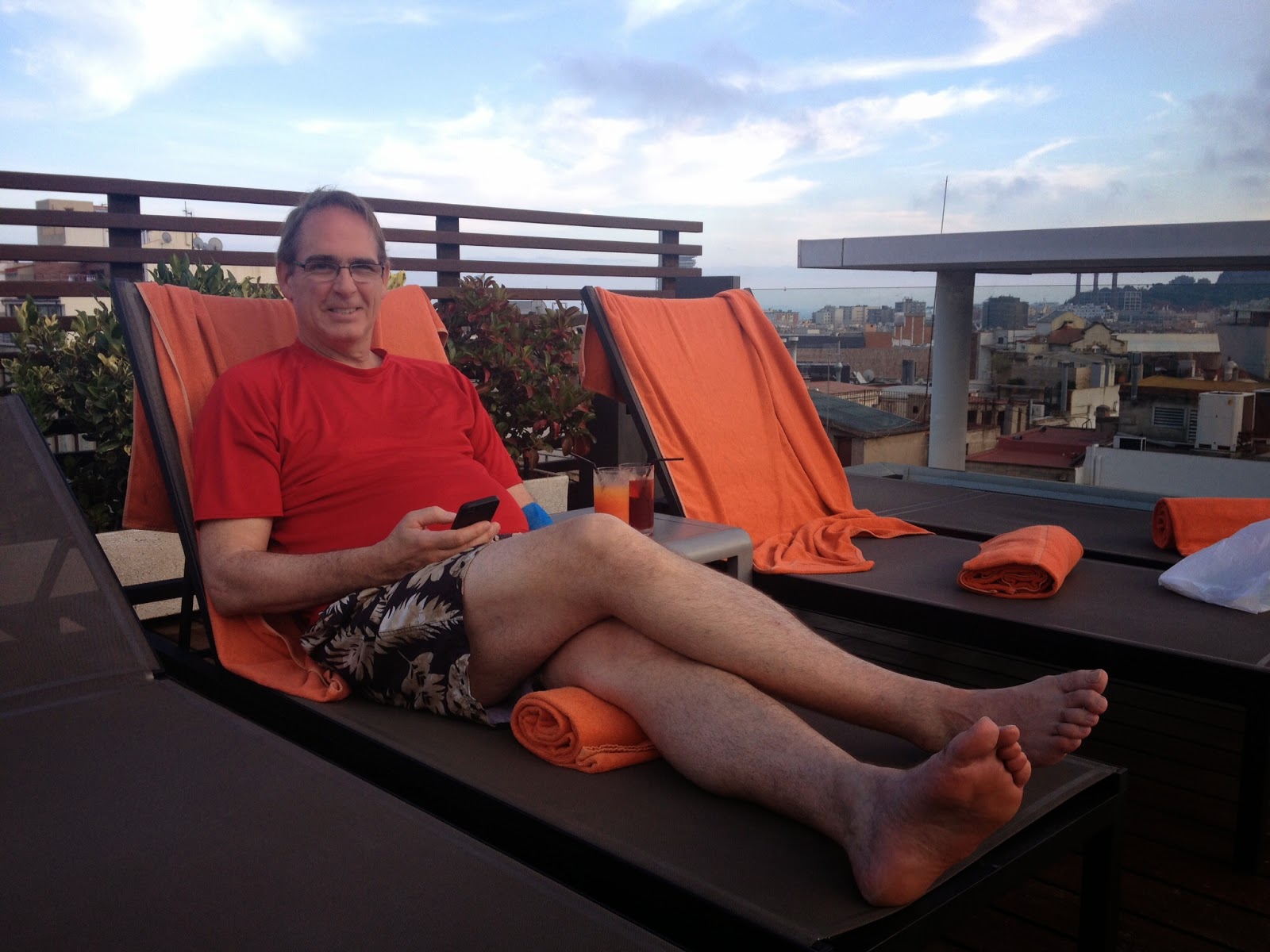
After our ride, we returned to our hotel and spent the afternoon with drinks on the rooftop pool which overlooks the city. We relaxed and then showered and walked to the El Borne area to dine at a Mexican restaurant called La Hacienda. We were thrilled to find a restaurant that offered margaritas, spicy nachos, and fajitas. and ate outside on the terrace to watch the many locals shop in the boutique shops in the area. After we ate, we walked to the Santa de Mar Basilica to hear a concert of Spanish
guitars. As in Budapest, the churches have concerts as fundraisers to provide for the maintenance of the church. The trio of Spanish guitars bounced off the stone walls in the sanctuary and the candle-lit, low-lighting of the church was magical. The Basilica was built by the people in a simplistic style and the construction of this church only took 55 years (from 1329 to 1384). It was destroyed by earthquake soon after it was built and then after restored, destroyed again by fire during the civil war. This historic church is a prominent icon in the Gothic neighborhood.

Saturday, we had breakfast and strolled in the Gothic barrio. We then negotiated the underground trains to go back to the La Sagrada Familia with tickets to visit the inside of the church. We have seen quite a few churches in our travels, but this one was extremely impressive. It is not unusual to build these European church for 200 years. I felt privileged to see this church in progress. They have been building it for over 100 years and expect to finish it in 20 years. It is a work in progress in modern times, but majestic none-the-less.

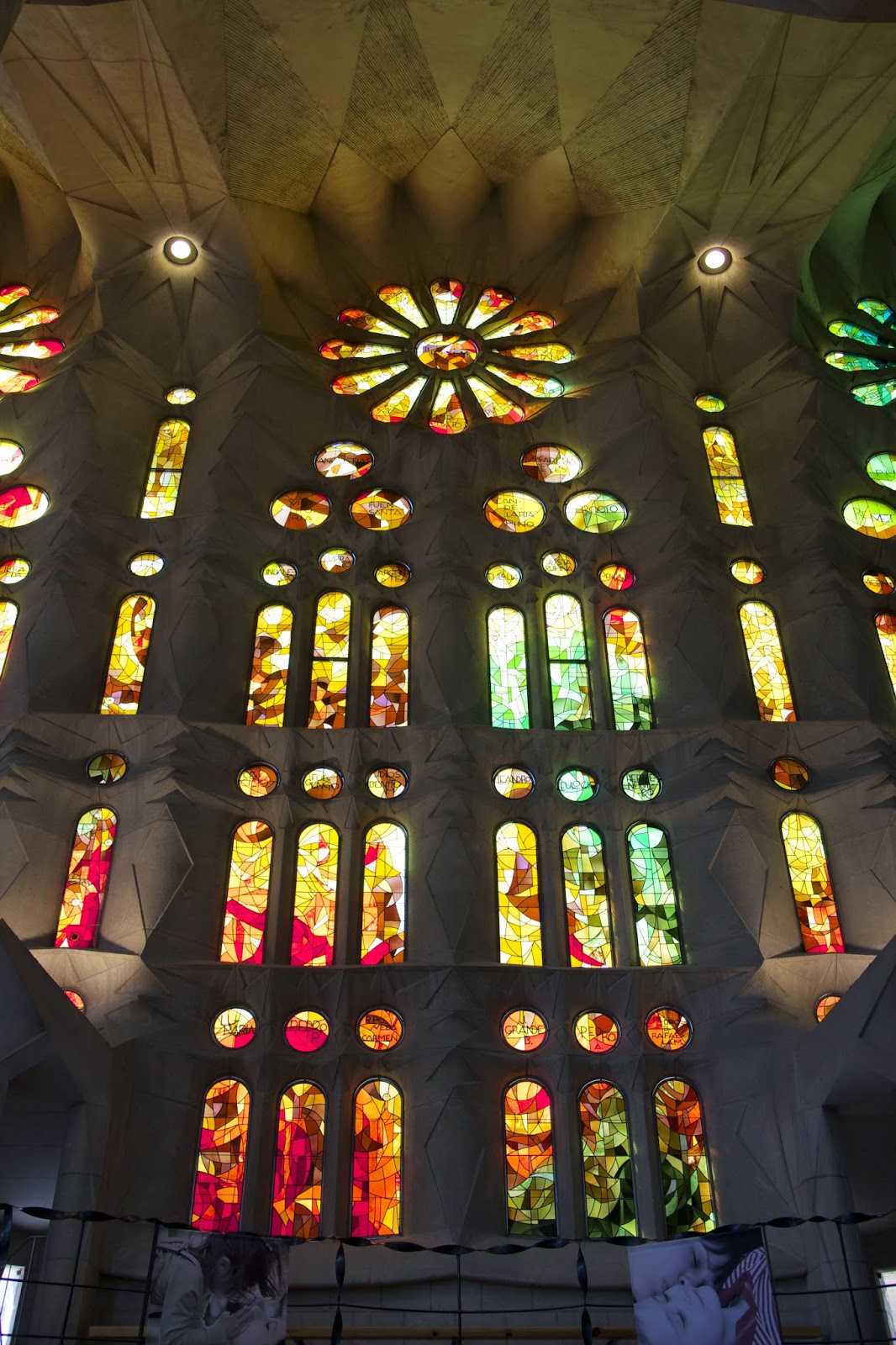
One side of the church features the nativity of Jesus and the Holy Family and the other side has the facade featuring the Passion. It is impossible to describe the detail involved - it must be seen.  The inside of the church has many facets and the colors in the windows were brilliant. The best feature of this church is the altar area. A crucifix hangs over the altar in a ring of candles. Above the crucifix is an opening in the ceiling that opens into one of the towers. In my mind, this is what the opening of heaven must be like.

I sat in meditation and cried at the beauty of this sacred place as I felt bathed in the Holy Spirit near the altar.  We visited the museum under the church that told of the building of it and featured the design of Gaudi.

We left this area and pondered what to do with the rest of our afternoon. The funicula was broken that takes one to Mont Juiic to get a view from the top of the city so that was not an option without hiking shoes. We considered shopping in the El Born district, but had no room to take anything back in our suitcases. It was too nice of the day to go inside to the Picasso museum and we didn't have enough time to visit Montserrat, a beautiful Benedictine monk mountain retreat about one hour North West from Barcelona by train. We considered renting a bike to ride along the coast line to the Maresme beaches 1 hour away.  However, Paul had crashed his bike on the ride the day before and his elbow was hurting and his leg still had road rash.

We walked by a couple of Gaudi houses in the area, Casa Battlo and La Padrera (but didn't go to the Parc Guell where more houses are located) and strolled the Las Ramblas to return to our hotel. We returned to the rooftop bar at the hotel to research whether or not we could hear live music at the Palau Musica and they were sold out for the night. We then went back to the same Mexican restaurant for dinner (did I say that the Mexican food was a real treat for us after 6 months without?). We left early the next morning to return to our European home. Yes, we will go back to Barcelona to finish up the final notes to complete this symphony.