Showing posts with label bicycle tour. Show all posts

Sunday, August 24, 2014

Berlin - The Presence of Absence


So far Berlin might be my favorite city in Europe. Paul and I decided to go there on a whim when our bike ride from Munich to Prague was canceled the week before we were supposed to go (that's another story . . . ). In Europe you can just jump on an airplane for the weekend easily and cheaply. And so we did. We arrived on a Friday afternoon and stayed at the Hotel Am Steinplatz in the Steinplatz neighborhood of formerly West Berlin. The hotel is decorated with a 1920s theme, There are videos playing in the hallway and lobby that were shot in 1920s Berlin in the neighborhood that we stayed in. Our room had a photo of a 1920s Berlin flapper on the wall. Germany had fought in WWI which ended in 1917, but the videos of the city at that time didn't show any effects of the war.

 We walked around the neighborhood and found nice shops and many outdoor restaurants. The neighborhood had a vibrant feel to it and the restaurant our first night was at a tapas bar called Mar Y Sol. The food was tasty and uniquely prepared. In a funny way, we felt like we were home. Berlin is a green city, the vibe was alternative and edgy, and there were bikes and street musicians everywhere. Except for the language difference, it almost felt like we were in Austin, Texas.

And then we noticed 4 inch by 4 inch brass nameplates
in the sidewalks in front of many houses and at the corner of many streets. These plates had the names of the Jewish person that lived in that house prior to being murdered by the Nazis during WWII. There is a concept called the Presence of Absence, introduced by Micha Ullman when Berlin started to be restored. What used to be there, isn't any longer. The people that used to live there had their lives cut short by evil. And the absence - what was lost by war - is noticeably present in the way the city was rebuilt. One monument had the shelves of a library with no books on them. Hitler had a book burning in 1933 in one of the central areas of town that was known for being an academic area. 40,000 people participated and they burned a total of 25,000 books identified by Hitler as being anti-German. Scars of Nazi Germany still exist throughout the city.
The next morning we jumped on the train and got off in the Alexanderplatz - in former East Berlin where we met a group from Fat Tire Bike Tours to tour Berlin. We met under a TV tower that was built by communist Russia who occupied East Berlin, to show off their advanced technology to West Germany. Communist East Germany had to have it's own broadcasting system to restrict the programming that it allowed it's citizens and to show West Germany that it didn't have a monopoly on new technolgoy. We could see in the sunlight that the shape of the ball at the top allowed for a reflection cross to be portrayed onto the ball of the tower. The West Berliners called this the Pope's Revenge. We were fitted with our bikes quickly and we were off.

Fat Tire Bike Tours is based in Austin, Texas and has a shop also in London, Barcelona, and Paris. Neal, our guide was very knowledgeable about the history of the city and was easily able to answer all of our questions on the 3-hour tour. We knew we would be very interested to see how the city has been restored after WWII, both in East and West Berlin and to see the differences between the two parts. We knew the city had been rebuilt after the Russians bombed and pretty much destroyed the entire city at the end the war.

On our ride, it was intriguing to me to see how they rebuilt the city to make it look old. The stone for many building restorations was burnt before it was cemented in place to give it a centuries old look. There were several churches restored after the war, but they were used as museums, not churches in Communist Berlin. Several buildings still had the evidence of artillery fire from the war - 70 years earlier. We saw the area where Hitler's bunker was located. Hitler committed suicide May1, 1945 and he had asked that his body be burned so that it wouldn't be hung in effigy as Mussolini's had been in Italy. There is a dirt parking lot where his burnt body was found. The bunker was later  destroyed and was so thick that it had to be bombed out of the ground.

We visited 2 of the 3 remaining stretches of the Berlin Wall. Like many Americans, I've always just taken freedom for granted.  In Berlin, the concept of freedom,  and how precious it is, permeated just about every block we traveled.  


There is an imprint of where the entire wall used to surround the city embedded in the streets as we rode along. The remaining sections of wall are almost entirely covered with graffiti, some of it very nice artwork. When Reagan said the famous words "Mr. Gorbechev, Tear down this wall", it was not taken down by government officials or a wrecking crew. It was taken down by the people in the streets who were reclaiming their freedom. My husband Paul thought the graffiti on the wall was a bit disrespectful of something historic, but I saw it an expression of freedom by the people that tore it down. A person affected by Communism, who was walled off from freedom, has the right and privilege to be creative on the very wall that restricted him for 28 years. In riding through Tiergarten, a large park and garden in the center of the city, many men were sunbathing in the nude in the open field. This might be another edgy expression of being free. 

We saw Checkpoint Charlie and the site of a museum that stands where the offices of the Stasi (SS) used to be. It's called the Wall of Terror, and is a memorial explanation of what the Nazi SS did in Warsaw, Poland. It's staggering the evil and destruction of so many lives that were caused by the Nazis. He oversaw the killing of 11 million people, 6 million of those were from Poland. This museum let the horrors be known and felt that were the result of the evil of Hitler's empire.

We rode by the Jewish Memorial. From the outside, it gives the impression of undecorated grave markers. To go into the memorial gives a very different experience. The floor of the park is created in rolling waves, and the stones are very tall. To walk along the rows, you get the feeling of not having sure footing and it's a bit disconcerting to not know what is around the corner as you turn. I felt it was a beautiful way to memorialize the Jewish people that were murdered.  Hitler also killed homosexuals, Roma Gypsies, as well as Jehovah's Witnesses, priests, and ministers of all denominations and the disabled. There are several more memorials throughout the city. I have been in many parts of Germany, but I was deeply impressed in Berlin to see the honor, solemn respect, and apology that is given the victims of the war. In the rest of Germany, it is hardly spoken about.

To visit Berlin is to have hope.
The practice of rebuilding, forgiveness, and healing gives Berlin a very unique soul to be enjoyed when visiting. Healing those wounds in history is the central story in all of Europe. Berliners are acknowledging the evil of the past, but are also letting hope, not the hurt, shape it's future.

Wednesday, August 6, 2014

Belgian Beer Tour - A Pilgrammage to Westvleteren and Saint Sixtus Abbey

It is a small world. We are fortunate enough to actually know people in Europe before we moved here. Our son-in-law is from Belgium and his parents live only 2 hours away from us in Holland.  We love our son-in-law for many reasons, but the added bonus when he joined our family was getting to know his parents, who we consider to be our very good friends.

We really enjoy being with Vera and Joos. Even though we speak different mother tongues, we have similarities that surpass all cultural barriers.  We both value our families very much, we understand the importance of serving God and others, and we are adventure seekers. Our last adventure was to explore a Belgian Trappist brewery and additionally a non-Trappist brewery by bicycle tour.

In 1997, eight Trappist abbeys—six from Belgium (Orval, Chimay, Westvleteren, Rochefort, Westmalle and Achel), one from the Netherlands (Koningshoeven) and one from Germany (Mariawald) – founded the International Trappist Association (ITA) to prevent non-Trappist commercial companies from abusing the Trappist name. They have guidelines to be able called a Trappist beer. Only beer brewed in a Trappist monastery under the supervision and responsibility of the monks may be called a 'Trappist beer'. The monastic community must be involved in the brewing, the choices of ingredients to include in the brew such as hops, barley malt and yeast and the water used to brew it, as well the marketing of the beer. The beer is sold only for financial support of the monastery and for other benevolent causes. Usually then, a limited quantity of beer is made - enough only to support the monastery and the monks within it.

We rode our bicycles with Joos and Vera to visit the Westvleteren brewery. It was founded in 1838 inside the Trappist Abbey of Saint Sixtus of Westvleteren, not far from the hops-producing town of Poperinge,  and the medieval city of Ieper where Joos and Vera live. We arrived at the abbey in time to join a prayer service with the monks and a few locals who were present.  We walked through the halls of the monastery, through the garden to the chapel. Prayers commenced when a monk rang the bells in the entry way. They interrupt the beer making to have prayer services four times a day. It was a very special experience to be able to observe and participate in the prayers of the monks. They were praying the Psalms and I guess I have picked up enough Dutch - as well as know enough of the Psalms - to be able to follow and sing most of the prayers during that 20 minute service. On our way out of the abbey, we quietly passed the guest rooms that are available for people who would like to make a silent retreat in the monastery.

The brewery currently employs three secular workers for various manual labor tasks, however the primary brewing
is done by the monks only. It is the only Trappist brewery where the monks still do all of the brewing. Of the 26 Cistercians who reside at the abbey, five monks run the brewery, with an additional five who assist during bottling. All of this is to support their prayer life and the buildings they live in.

We walked over to the tasting room to buy lunch and beer - a bruin Westvleteren 12 for me with 10.2 percent alcohol. It is known to be the best beer in the world by a percentage of beer aficionados and judges. It's by far the best beer I've ever tasted. Only a little bit of extra beer is sold outside of the tasting room in small quantities weekly from the doors of the monastery itself, to individual buyers with reservation only. Thanks for our hosts, we were able to come away with six bottles of the world's best beer, which we are securely guarding in an undisclosed location until we can consume it.


After lunch, we then pedaled to another little village in nearby Watou (across the street from the French border) to  St. Bernardus brewery. In 1946, the St. Bernardus brewery was granted a license to brew beer under the St Sixtus name. However, this agreement ended in 1992 and then St. Bernardus re-opened as a non-Trappist brewery. They still brew beers of similar style to Westvleteren, but now under their own name and without the Trappist seal. We miscalculated the time involved to travel from the Abbey to our second brewery, so we rode quickly on our bikes to be able to take in a tour of the brewery at our appointed time. Our tour guide was our son-in-law's Latin teacher from high school. Our guide was gracious to offer the tour in English as well as Dutch so that we could understand the brewing process. We tasted the St. Bernardus beers and also got a souvenir drinking glass with the sampling of beers to take with us. The saddle bags on the bikes were filled to the brim with very good beer - our reward for cycling for over 60km for the day.
Next Up: Aachel is very close to where we live and we have ridden our bikes to the Sint Benedictus Abdij - De Achelse Kluis where the Achel beer is brewed. We are not able to actually visit the abbey there, but the brewery shop is open for tasting. It is a good atmosphere to relax and enjoy a good beer as well as help the monks financially support their monastery, They do have a window to allow viewing of the some of the process. We watched the cleanup one day at the end of brewing.

We have also ridden along the canals to Tilburg in the Netherlands, but missed a visit to the Koningshoeven Abdij, where Trappist monks brew La Trappe beer, the Netherlands only Trappist beer. We will return there to taste the La Trappe beer made by the Trappist monks.

Monday, July 14, 2014

Saying Yes

My husband Paul loves to ride his bike. I rarely joined him in Texas, citing how uncomfortable I felt on the roads near Austin. He and his riding buddies ride on the side of the road right next to the cars and trucks. It scares me to ride there.

I feel differently about cycling after our move to Holland. Cycling is very easy here, with as many cycling roads (actual separate roads) here as there are for cars. Bikes have the right of way most of the time at intersections and if not, then there is a separate light for them. It is very flat in the Netherlands and the weather is cool - even in the summer. They have bike route system to travel the entire country, and maps that make it easy to use. I have a bike with bell and I feel like a kid again.

Paul's German biking buddy Stefan (joining Paul on his last 8 MS150 bike rides from Houston to Austin) cooked up a proposal for Paul and myself, his wife Petra and of course Stefan to bike the newly created cycling route from just outside Munich to Prague along the rivers. It is a total of 440km going along the Danube, Moldau, Malse, Otava, and  Vltava Rivers. The elevation from Munich to Ceske Zleby is more than I was comfortable with, so we agreed to start after the climbs and will ride 315 kilometers over 5 days to Prague. We'll carry our stuff in panniers, and stop in pensions or zimmers along the route. These are usually a room in a private home with breakfast in rural areas, literally a bed and a breakfast. That also should be a part of the fun.

It took me several weeks to agree to this. Even with the ease of cycling and the enchanted idea of riding near rivers and castles, the thought of doing this terrified me. I spent countless hours finding and translating details about the ride. I got out the calculator and figured out the steepness of the climbs. I read blogs and heard about the busy traffic along parts of the route. I spent much time wondering how fit I am and could I even do this? After all, I was the fat kid in gym class. It finally came down to this question: What am going to regret more? Am I more afraid of dying or am I more afraid of not living?

I said yes.

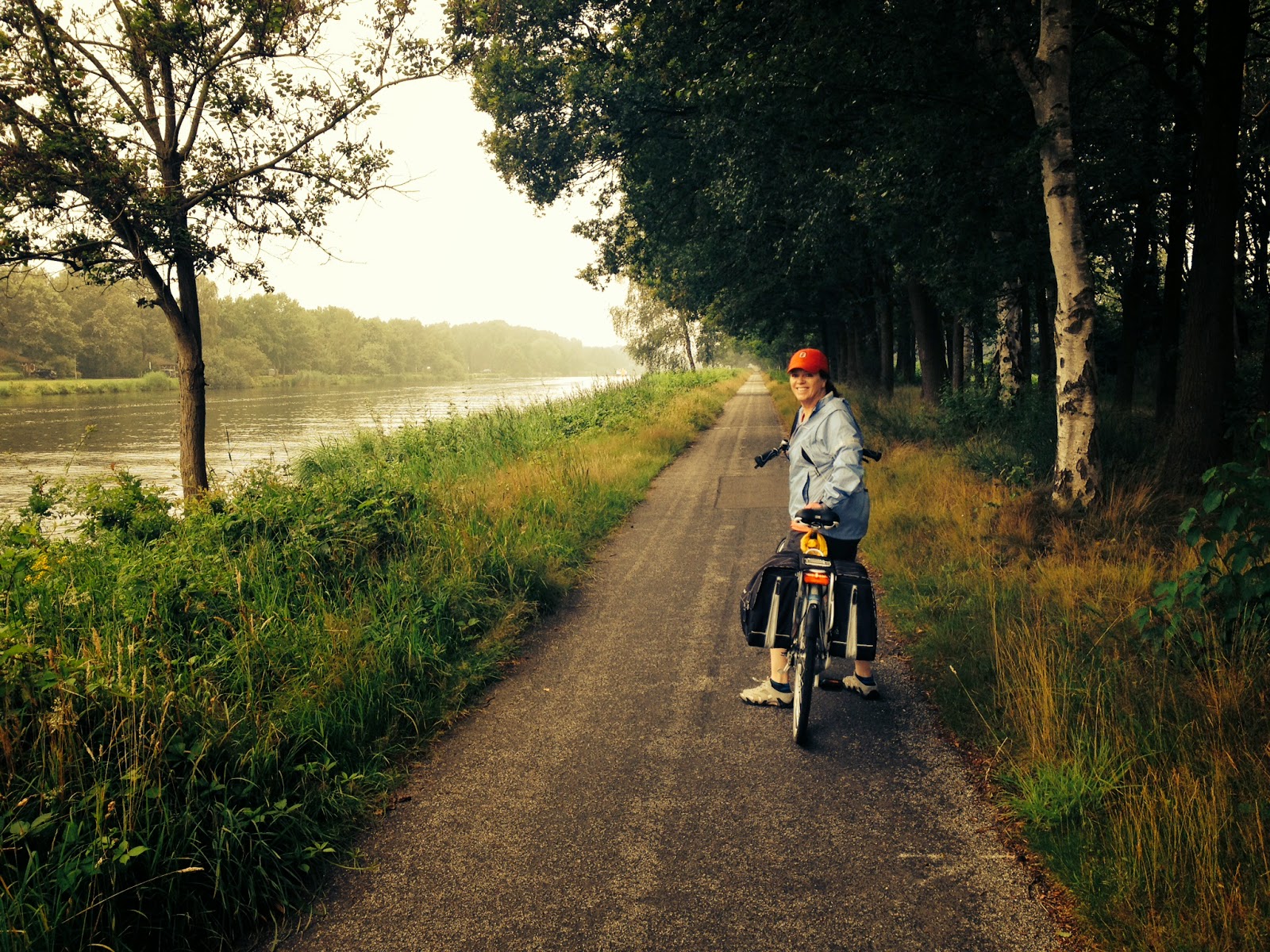
I've been riding on weekends and several times during the week to get used to the bike seat and the miles. I've made a packing list that includes the essentials (after all, there is only room for what is essential). This past weekend Paul and I rode 68 kilometers in the rain to Tilburg on the cycling paths from our apartment. We rode along the canals for much of the ride, passing through the woods to windmills, and area farms with goats, and miniature horses and baby deer.

I still don't know if I can do this ride, but I'm open to the experience of trying it. The biggest adventure might be conquering those inner struggles rather the miles on the bike and the inclines. Stay tuned  . . .


Thursday, May 8, 2014

Not All Those Who Wander Are Lost - Honest First Impressions

I am realizing that the best part of this adventure is the opportunity to  wake up each morning with the day completely undefined. It's like looking at a blank canvas and deciding what color or object to paint on it.   I wake up in a new place, without most of the things that made me comfortable in my former home in Texas. I don't have a schedule, nor people to meet, and really not a clue where essential things are and how to get to them. What would have made me panic before, I now embrace.

This journey involves a deep change in the ideas of how to live and also the internal change that goes along with this. The first week, I've definitely had more questions than answers and have had to improvise and rethink how I normally do things. I love the process.

To get assimilated into this new culture, my first purchase was a Dutch bike. My bike has saddlebags on it to carry  items home from the markets. It also has a dual locking system to prevent theft (the biggest crime in the Netherlands I hear) and a bell on the handlebars to let others bikers know that I'm behind them (like I'm going to pass or something?). On the way home from the bike shop with my new bike, it began to rain and then hail on me. I ducked under an awning to avoid the pounding from the hail. But after the hail stopped, I proceeded to ride in the cool rain and laughed all the way home. The first adventure to the market, I made a total of four  trips in one day to get ready for my sister's visit. I could only buy at one time what I could carry home on the bike. There is a simplicity of buying only what you need for the day and also only buying what you can carry home on the bike that drives choices at the market. It changes the way I think about things.

It takes several weeks to get a new cell phone in the Netherlands. It was huge for me to go without a phone. I've had a phone in my hand for the past 5 years with many calls every day for Picture This! And here I was traveling around in a new place and didn't have the phone to rely on for maps and for that desperate phone call to Paul if I got lost. It made me pay attention to where I was and where I was going. It frightened me a little bit to be without it, but it was freeing as well. It occurred to me that it's not a bad thing to just wander around a little bit. Half the fun of travel is that it brings this feeling of lostness, of going places in a way that you haven't gone before. In fact, true places aren't really on any map.

Not knowing anyone and also not knowing the language is giving me some time to be alone.  It's not really loneliness, but solitude. It's not an empty space. I've mastered "Good morning or Good day" and hello "Hallo" in Dutch to greet those around me.  At the city street market, I asked for 4 komkommers. An older lady laughed with the market clerk at my request (pretty absurd really to use the English number four and use the Dutch word for cucumber).  I was surprised at her response, but just joined in her laughter. Laughter is the same in all languages.

I'm hoping this journey gives me an opportunity to travel around and visit many new places. I hope it also allows me to go the distance within.

imple grateful thought turned heavenwards is the most perfect prayer
Read more at http://www.brainyquote.com/quotes/quotes/d/dorislessi384119.html#7soOtFIUk7rYJzqK.99
purpose of art is washing the dust of daily life off our souls.
Read more at http://www.brainyquote.com/quotes/quotes/p/pablopicas102627.html#Cr670HfuPPEH3tta.99